Naomi Hull, RN, IBCLC, MPH, PhD Candidate, University of Sydney
National Coordinator, World Breastfeeding Trends Initiative Australia (WBTiAUS)
In Australia, voluntary regulations are placed on some manufacturers of breastmilk substitutes – CMF companies who have voluntarily signed an agreement that is authorised by the Australian Consumer and Competition Commission (ACCC) called the Marketing in Australia of Infant Formulas: Manufacturers and Importers (MAIF) Agreement. It was created in 1992 as a response to the World Health Organization (WHO) International Code of Marketing of Breastmilk Substitutes (The Code).
The Code was introduced by the World Health Assembly (WHA) in 1981 as a targeted reaction to falling breastfeeding rates and the increase in marketing tactics used by CMF manufacturers to the detriment of infant health and safety. The aim of this Code is ‘to contribute to the provision of safe and adequate nutrition for infants, by the protection and promotion of breast-feeding, and by ensuring the proper use of breast-milk substitutes, when these are necessary, on the basis of adequate information and through appropriate marketing and distribution’ (Shubber, 2023). Every two years there is a chance for Member States to make additions in the form of resolutions, at the WHA to expand the scope in response to arising issues in the current environment. The scope of The Code in 2023 includes the marketing of all breastmilk substitutes (food and drinks) marketed to babies and young children up to the age of 36 months, bottles and teats. This year in May, the WHA member states will consider the inclusion of regulation of digital marketing of breastmilk substitutes.
In comparison, the MAIF Agreement only covers the regulation of marketing by manufacturers (not retailers) of breastmilk substitutes to babies up to twelve months of age and does NOT include bottles and teats and does not include unnecessary and probably harmful toddler milks. It is not mandatory and only applies to the signatories. It has not been updated since it was drafted in 1992, despite the onset of digital marketing strategies. If one of the few companies that are signatories to this agreement are found to be in breach the penalty is a light touch; they get named on the Department of Health and Aged Care (DOHA) website. We know this does not deter breaches, as there are some companies there that are repeat offenders. The monitoring also heavily relies on members of the public to submit complaints to the DOHA on a webpage that is difficult to find. Most of the public would not even know that this exists and is therefore left to volunteer breastfeeding advocates and not-for-profit organisations.
You can see where Australia fits in a global context in the WHO Status of The Code Report 2022 and read further analysis of the Australian situation in the World Breastfeeding Trends Australia report 2023 (Indicator Three). In late May, the 2024 Status of The Code Report will be released. Stay tuned for no improvement.
Evidence is mounting that self-regulation of the industry is not enough (Baker et al., 2023). We know that the commercial milk formula industry is a $ 55 billion dollar industry (World Health Organization, 2022a) and approx. 10% of this money is spent on marketing their products (Rollins et al., 2023). These are private companies whose fiduciary duty is to drive profit for their shareholders. CMFs are different as babies and children up to three years of age are profoundly affected by feeding practices. Information about these products must be free from industry spin.
A report from the WHO (World Health Organization, 2022a) found the following points:
- Formula marketing is pervasive.
- Formula companies use manipulative tactics – exploiting parent’s anxieties.
- Formula milk companies distort science to legitimise claims.
- The CMF companies systematically target health professionals with the aim of encouraging them to promote their product.
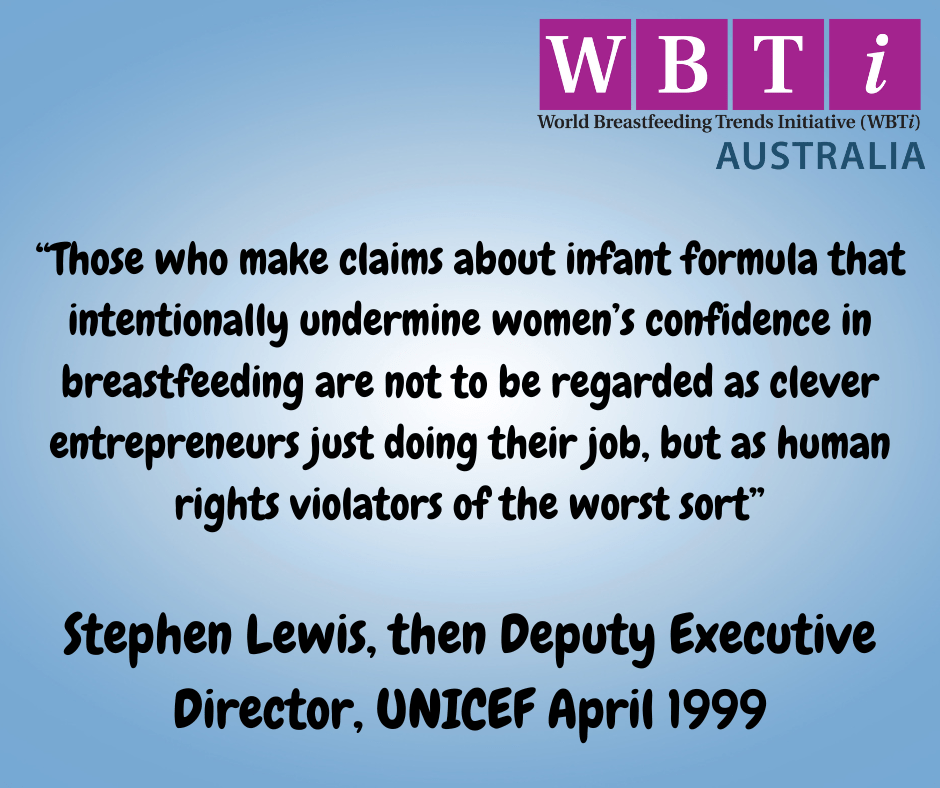
- CMF industry undermines parent’s confidence in breastfeeding.
The last time the Infant Nutrition Council (INC) applied for reauthorisation of the MAIF agreement with the ACCC there were many submissions in response to the draft determination raising concerns of these considerations. The ACCC called a pre-determination conference with those who made the submissions (including WBTiAUS) to explore the concerns further. In summary, the final ACCC determination stated there was public benefit in restriction of marketing of breastmilk substitutes, therefore they would reauthorise in the absence of an alternative. They declared concerns with the ability of signatories to advertise toddler milk products in identical packaging to infant formula, therefore having the effect of promoting infant formula. They were also concerned with the voluntary nature of the MAIF Agreement and that there were no real sanctions for a breach. The ACCC noted the significant concerns raised by submissions about the independence and transparency of the complaints handling process.
The ACCC made the decision to authorise for three years; a shorter period than initially thought. This was to provide ample time for the DOHA to undertake the review of MAIF they committed to in the Australian National Breastfeeding Strategy 2019 (ANBS).
The Australian Government has already undertaken four reviews of MAIF in the past 23 years, along with the Parliamentary Inquiry into the health benefits of breastfeeding. These were in 2001 (Knowles, 2001), 2007 (The Parliament of the Commonwealth of Australia, 2007), 2012 (Nous Group, 2012) and 2017 (Nous Group, 2017). The files of these reports are uploaded below as they are not available publicly. The previous reviews have only resulted in very minor changes to the administration of MAIF rather than its scope or ensuring appropriate punishment for breaches. Despite these four reviews, there has been little (or no) progress on the protection, promotion and support of breastfeeding in that time.
In April 2024 (even though it was completed in October 2023) the DOHA released the long-awaited final report from Allen and Clarke, the consultancy firm that undertook the 2023 review of the MAIF Agreement (Allen and Clarke Consulting, 2023). They found that the ‘voluntary, self-regulatory approach is no longer fit for purpose’ and that a ‘stronger regulatory framework in the form of a legislated, prescribed, mandatory code’ is required (Allen and Clarke Consulting, 2023). They did not recommend expanding the scope of any regulation to other parties (such as retailers). They said that there was ‘significant scope to improve the monitoring and enforcement of existing regulatory arrangements’ and a stronger system should be established (Allen and Clarke Consulting, 2023). Concerningly, there is a suggestion that policies should be established to enable donations of infant formula in emergencies and disaster contexts. This is in stark contrast to The Code, and Operational Guidance of Infant Feeding in Emergencies Core group.
So, what are WBTIAUS’s recommendations to the ACCC on the request for reauthorisation of the MAIF Agreement?
- The MAIF agreement should NOT be re-authorised. Only legislated regulations which are monitored and enforceable are sufficient to protect breastfeeding and infant feeding choices from commercial influence.
- In the short term the Australian Government could task the ACCC with monitoring and enforcement of consumer law
- That Australia moves towards the implementation of legislation that encompasses the full scope of the WHO Code and subsequent WHA resolutions. This legislation should be prepared by people with health and human rights expertise. An example of what that could look like is here.
The ACCC timeline shows that their decision will be handed down in September 2024. In the meantime, we hope to hear the DOHA response to the review.
When will the Australian Government respond to the commercial formula marketing playbook, digital strategies (World Health Organization, 2022b) and the booming sales of unnecessary (Australian Government, 2012; Fuchs et al., 2023) follow-on formulas and toddler drinks?
Link to Australian Breastfeeding Association’s video calling for change
References
Allen and Clarke Consulting. (2023). Review of the Marketing in Australia of Infant Formulas: Manufacturers and Importers Agreement Final Report. https://www.health.gov.au/sites/default/files/2024-04/review-of-the-marketing-in-australia-of-infant-formulas-manufacturers-and-importers-maif-agreement-final-report_1.pdf
Australian Government. (2012). Infant Feeding Guidelines Information for Health Workers. In: National Health and Medical Research Council.
Baker, P., Smith, J. P., Garde, A., Grummer-Strawn, L. M., Wood, B., Sen, G., Hastings, G., Pérez-Escamilla, R., Ling, C. Y., Rollins, N., & McCoy, D. (2023). The political economy of infant and young child feeding: confronting corporate power, overcoming structural barriers, and accelerating progress. Lancet, 401(10375), 503-524. https://doi.org/10.1016/s0140-6736(22)01933-x
Fuchs, G. J., III, Abrams, S. A., Amevor, A. A., & Committee On, N. (2023). Older Infant-Young Child “Formulas”. Pediatrics, 152(5), e2023064050. https://doi.org/10.1542/peds.2023-064050
Knowles, R. (2001). Independent Advice on the composition and modus operandi of APMAIF and the scope of the MAIF Agreement.
Nous Group. (2012). Review of the effectiveness and validity of operations of the MAIF Agreement: Research Paper.
Nous Group. (2017). Independent review of the MAIF Complaints Handling Process – review Report.
Rollins, N., Piwoz, E., Baker, P., Kingston, G., Mabaso, K. M., McCoy, D., Ribeiro Neves, P. A., Pérez-Escamilla, R., Richter, L., Russ, K., Sen, G., Tomori, C., Victora, C. G., Zambrano, P., Hastings, G., & Lancet Breastfeeding Series, G. (2023). Marketing of commercial milk formula: a system to capture parents, communities, science, and policy. Lancet (London, England), 401(10375), 486-502. https://doi.org/https://doi.org/10.1016/S0140-6736(22)01931-6
The Parliament of the Commonwealth of Australia. (2007). The Best Start Report on the inquiry into the health benefits of breastfeeding. Canberra
World Health Organization. (2022a). How the marketing of formula milk influences our decisions on infant feeding. How the marketing of formula milk influences our decisions on infant feeding (who.int)
World Health Organization. (2022b). Scope and impact of digital marketing strategies for promoting breast-milk substitutes.

 World Breastfeeding Trends initiative Australia
You must be logged in to post a comment.