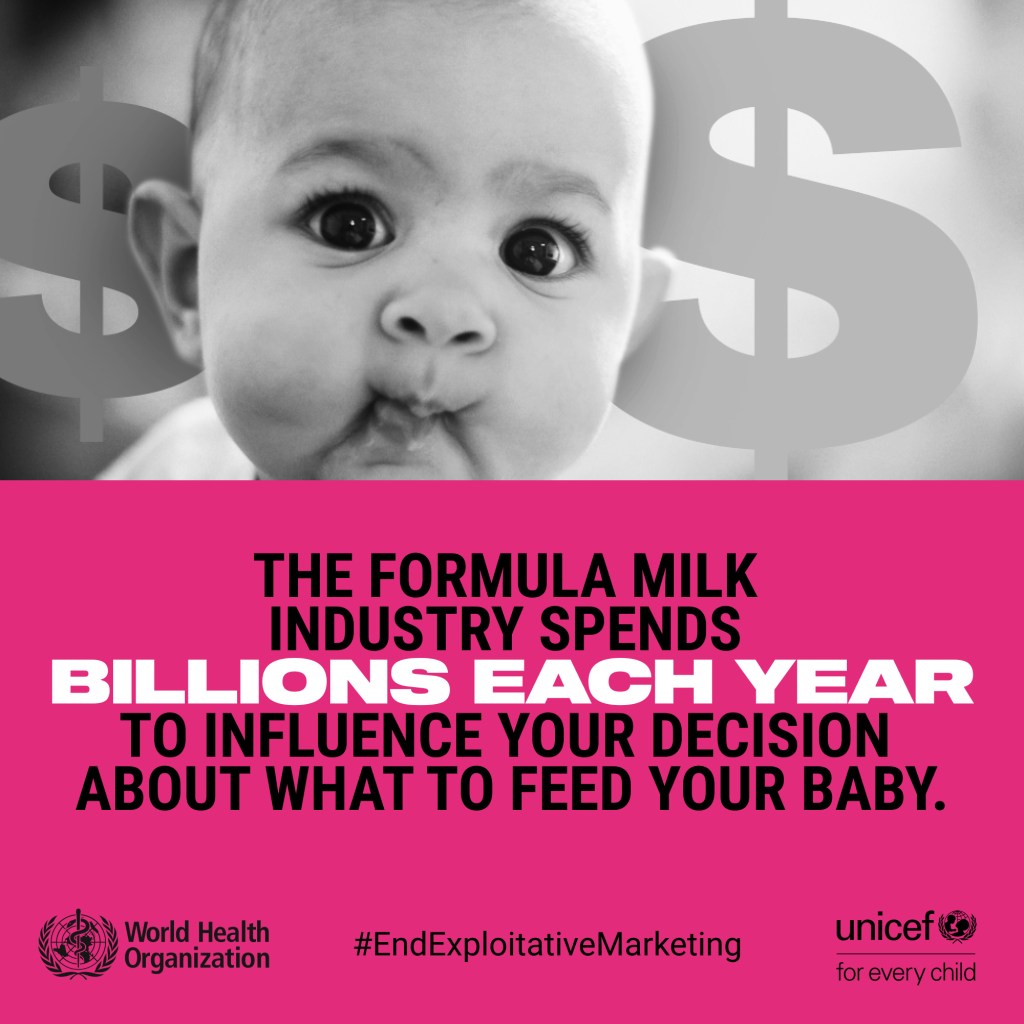
Implementing the International Code of Marketing of Breastmilk Substitutes in Australia
The WBTiAUS team call on the next Australian government to seize the opportunity for change to fully implement the International Code of Marketing of Breastmilk Substitutes and all subsequent World Health Assembly resolutions in the next term of parliament.
Australia needs:
1. Policy development and oversight by an independent body free of industry interference or commercial influence.
2. New health and consumer laws that ban all advertising and sponsorship by companies making, importing or distributing breastmilk substitutes (including of toddler formulas, or by retailers and health facilities).
3. These laws developed and implemented with meaningful penalties for breaches and robust and comprehensive monitoring of compliance.
Australian governments have failed repeatedly to end the predatory marketing of infant formula products to mothers and families. The time has come for them to step up. Although all Australian health ministers endorsed an action plan to end inappropriate marketing of infant formula and breastmilk substitutes in 2019, nothing happened except more taxpayer-funded reviews. The Australian Competition and Consumer Commission (ACCC), had oversight of a voluntary agreement, but in 2025 determined that it was ineffective.
Self-regulation is a well-documented strategy by industry to avoid effective policies to protect breastfeeding from marketing. As studies in one of the world’s leading medical journals – The Lancet – showed in 2023, Big Formula runs interference in politics and health systems to ensure that breastfeeding policies – such as baby friendly hospitals and paid maternity leave – are underfunded and ineffective. So where to now?
The International Code and global benchmarking
Recognising the vulnerability of new mothers and their babies to formula marketing, the International Code aims to promote health by protecting breastfeeding and banning promotion of all breastmilk substitutes. The Code covers so-called ‘toddler’ formulas, which were invented to get around national laws banning the promotion of ‘infant’ formula in many countries. Toddler formula is unnecessary according to Australian nutrition policy and possibly harmful to children’s nutrition and health according to the World Health Organization.
In 2023, the World Breastfeeding Trends Initiative Australia (WBTiAUS) assessed Australia’s policies against an international benchmark which included Australia’s performance on breastfeeding protection and International Code implementation. Here is an explanation of the ten indicators.
Australia scored badly, landing third from the bottom on a global ladder of over 100 countries.
The WBTiAUS Report also showed that Australia has some good policies but doesn’t act on them: all words but no action.
Costs and consequences
How babies are fed affect lifetime health and economic opportunities, and health system costs. Decisions about using breastmilk substitutes should not be influenced by companies whose main goal is profit. Yet these companies use their global resources to market to health professionals and parents, ensuring that formula is the easy fix for any breastfeeding challenges rather than access to breastfeeding support.
In Australia, one in three new babies is fed formula before leaving the hospital. Yet most new mothers intend to breastfeed, and doing so helps their body adjust after childbirth. However, health professionals lack the knowledge and skills on helping women to breastfeed.
Undergraduate education does not enable health workers to support mothers, despite global standards. This gap is filled by industry-sponsored programs. Mothers struggling with early breastfeeding challenges are left unsupported, depressed and angry (often mislabeled as “feeling guilty”).
How babies are fed also affects women’s health by helping with child spacing and reducing the risks of breast cancer risk, other reproductive cancers and chronic diseases. Yet while funding of the Australian Breastfeeding Association’s National Breastfeeding Helpline will continue, not a cent was allocated towards progressing implementation of the Australian National Breastfeeding Strategy in the government’s half-billion-dollar federal budget for women’s sexual and reproductive health.
How babies are fed is also a national food security issue. In the US in 2022 we saw what happens when babies depend on formula products. A major manufacturing plant was shut down after its contaminated formula killed several babies. Nationwide shortages of infant formula hurt families already struggling to afford it in a cost-of-living crisis.
Reviews instead of action – at taxpayer expense
Five reviews of industry self-regulation of commercial milk formulas and baby food marketing in Australia have taken place since 1992. These taxpayer-funded reviews, including one by the bipartisan parliamentary Best Start Inquiry, repeatedly recommended comprehensive legislation to stop exploitative marketing, including by retailers such as supermarkets and pharmacies and bringing toddler formulas within scope. The exception was a 2012 review by the NOUS consulting company which nonetheless concluded that toddler formulas should be visibly different from infant formula to avoid confusing consumers. Successive governments did not enact any substantial recommendations from these reviews, nor have the Department of Health and Aged Care or the Food Standards Authority of Australia and New Zealand (FSANZ) prioritised action even when the consequences included the deaths of two toddlers fed solely on toddler formula products by a confused and distressed mother.
Since 1992, millions of taxpayer dollars have been spent on funding the industry’s increasingly opaque complaints management system (MAIF Complaints Committee). The administration of this committee bounced between government and industry from 2013. Another review in 2017 saw it move back into government though without any financial disclosures. Regardless, the taxpayer paid.
With the end of the MAIF Agreement, the next Australian government has the opportunity, and indeed the obligation, to fix the regulatory farce of past decades.
Our mothers and babies have waited long enough for support to breastfeed and protection of their decision. Our country’s health depends on reducing our dependence on the $500 million Australian baby milk market.
If this is something that resonates strongly with you please share far and wide and in particular with your local candidates. You can sign on in support by providing your details HERE.
Signed by the following
| Dr Julie P Smith Honorary Assoc Professor Australian National University Adj Assoc Prof, University of Sydney, Assoc Prof, University of Canberra WBTiAUS Core team member | Naomi Hull RN, IBCLC, MPH (Nutrition) PhD Candidate, School of Public Health, University of Sydney WBTi Aus Country Co-ordinator | Victoria Marshall-Cerins Executive Officer Australian Breastfeeding Association |
| Prof Sharon Friel PhD, FASSA, FAHMS ARC Laureate Fellow and Professor of Health Equity Director, Planetary Health Equity Hothouse Director, Australian Research Centre for Health Equity | Dr Phillip Baker ARC Fellow, Horizon Fellow Sydney School of Public Health University of Sydney | Dr Louise Wightman PhD, MLM, CFHN, RN, RM. Chair, MCaFHNA Maternal Child and Family Health Nurses Australia |
| Heather Gale RN/Endorsed Midwife/IBCLC/PGDNE/MN WBTiAUS Core Member Lactation Consultants of Australia and New Zealand (LCANZ) Member | Dr. Nupur Bidla (PhD) Central Coordinator, Breastfeeding Promotion Network of India (BPNI) Member, Nutrition Advocacy in Public Interest (NAPi)-India Member, Global Council, International Baby Food Action Network (IBFAN) Assessor, Breastfeeding Friendly Hospital Initiative (BFHI)-India | Dr Catharine Fleming Senior Lecturer Public Health BSc (Hons), PhD (Nutrition and Dietetics) Executive Member, Infant and Toddler Foods Research Alliance |
| Professor Helen Hodgson Director National Federation for Australian Women | Professor Karleen Gribble School of Nursing and Midwifery Western Sydney University | Dr Libby Salmon BVSc, MVS, PhD Research Officer, Australian National University WBTI Australia core team member Breastfeeding Counsellor, Australian Breastfeeding Association |
| Dr Susan Tawia BSc PhD Dip Breastfeeding Mngt Cert IV Breastfeeding Ed WBTiAUS Core team member | Dr Elaine Burns RM, RN, PhD Associate Professor of Midwifery Western Sydney University WBTiAUS Core team member | Monique Boatwright BA (Media&Comm), MHumNutr, PhD Student and Research Officer, The University of Sydney |
| Decalie Brown RN, RM, IBCLC, CFHN, BHMtg (Info) JP, WBTiAUS Core team member | Bridget Roache RN, Midwife, IBCLC, MSc(Res), Managing Director Facts of Life Lactation Education | Julie-Anne Harrison IBCLC, RM and Child Health Nurse Private Practice IBCLC ‘A Little Help’ |
| Azure Rigney Vice President, Maternity Choices Australia | Tan Nguyen BOralHlth GCertDenThrpy MPH (Melb) MSc (Clin Ed) (Edin) Casual Research Fellow, Deakin University | Louise Ryan Child Health Nurse IBCLC Maitri Lactation Support |
| Dr Kaitlyn Brunacci MBBS, BMedRes, SCHP, NDC, IBCLC Cert IV Breastfeeding Education (Counselling), PhD candidate | Amy Harrison Early Childhood Teacher, Breastfeeding Counsellor, Australian Breastfeeding Association | |
| Erica Thwaites BPsychSc, Family Response Facilitator | Madeleine Munzer Consumer Health Advocate, Independent Breastfeeding Counsellor | |

 World Breastfeeding Trends initiative Australia
You must be logged in to post a comment.